https://www.marketwatch.com/story/gileads-stock-has-fallen-21-since-april-30-underscoring-investor-questions-about-remdesivirs-potential-2020-08-31?mod=mw_quote_news
In the four months since Gilead Sciences Inc. first received
emergency authorization for the experimental COVID-19 drug remdesivir,
its stock has done the opposite of what you would expect — it has
dropped 21%.
The decline is still evident even after the drug manufacturer received a new emergency-use authorization
from the Food and Drug Administration on Friday that broadens the
allowed use of remdesivir in patients who have been hospitalized with
moderate forms of COVID-19, not just the severely ill.
Shares of Gilead
GILD,
+1.45%
were up 1.9% near the close of trading on Monday.
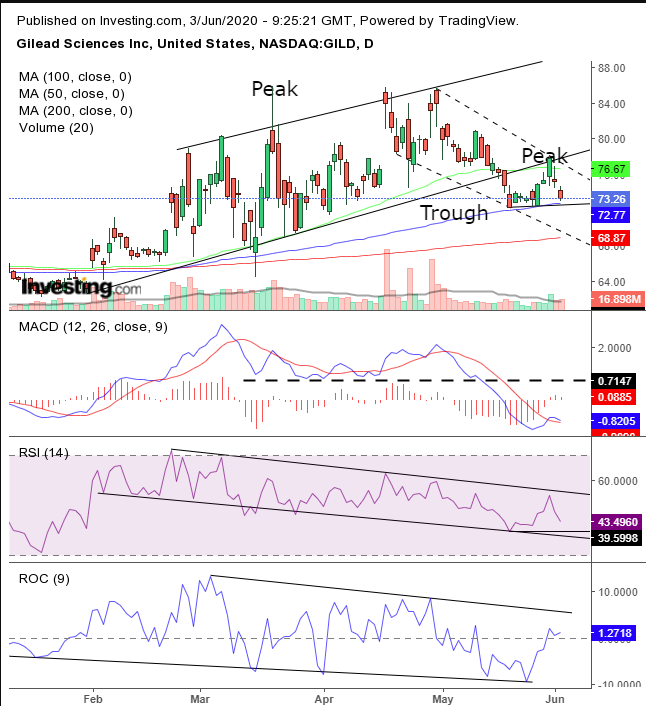
Gilead’s stock hit a year-to-date high of $84 on April 30,
which was the day it released the first comprehensive set of clinical
trial data about how remdesivir performed in severely ill COVID-19
patients. The FDA awarded the EUA on May 1. (The stock’s low for the year was $62.63 on Jan. 21.)
Coronavirus update:U.S. case tally climbs above 6 million and FDA head says he won’t be pressured to rush out a vaccine
One Wall Street analyst attributes the drop-off to market
skepticism around remdesivir’s staying power. Much of the excitement for
remdesivir and Gilead stems from the fact that the drug was the first
new COVID-19 treatment to receive an EUA during the early stages of the
public health crisis in the U.S.
“Its utility may be continually lessened going forward as
better therapies emerge,” Raymond James analyst Steven Seedhouse wrote
in an Aug. 27 email. “Dexamethasone and perhaps even convalescent plasma
already appear to be good alternatives to treat hospitalized patients.”
Researchers in the U.K. reported in mid-June
that the steroid dexamethasone can reduce the risk of death in COVID-19
patients, which is a far more definitive clinical finding than
remdesivir’s ability to reduce recovery times for some hospitalized
COVID-19 patients. The FDA last week granted an EUA to convalescent plasma as another new treatment for coronavirus patients.
“The data that were relied upon for emergency-use authorization
of remdesivir have never been followed in my view by any more
compelling data including any evidence that a bona fide survival benefit
is conferred by remdesivir,” Seedhouse added. “In fact it’s the
opposite, [and] there has been persistent skepticism backed by
data/analysis.”
Many but not all of the
so-called virus stocks — companies developing and in some cases selling
tests, treatments and supplies used in the treatment of COVID-19
patients — are outperforming standard indexes like the S&P 500
SPX,
+1.53%
and the Health Care Select Sector SPDR Fund
XLV,
+2.00%.
However, Gilead’s stock has struggled to maintain its momentum since April’s peak.
Looking at the last three months, Gilead’s stock is down 14.6%.
The S&P 500 has gained 15.8%, and the Health Care Select Sector
SPDR Fund is up 4.3%. Abbott Laboratories
ABT,
+2.71%,
which has received emergency authorization for six COVID-19 tests,
has watched its stock jump 15.2%. Shares of Moderna Inc.
MRNA,
+2.21%,
which is developing one of the front-running COVID-19 vaccine candidates, have rallied 4.9%. Johnson & Johnson’s stock
JNJ,
+1.52%
is up 3.3% over the last three months as it has moved forward with a vaccine candidate of its own.
However, shares of Pfizer Inc.
PFE,
+0.86%,
which is jointly developing COVID-19 vaccines with BioNTech
BNTX,
+7.23%,
are down 1.2%.