NEW
YORK -- U.S. President Donald Trump has tested positive for the
COVID-19 virus, roughly a month before the Republican incumbent's
election day showdown with Democratic challenger Joe Biden.
American
politicians and world leaders alike have wished Trump and his infected
wife, Melania, a speedy recovery. But the diagnosis brings to the fore
the issue of what happens to the election if a major-party candidate
falls seriously ill or even dies.
Here are five things to know
about possible outcomes for the administration if Trump cannot continue
serving, as well as how the presidential election might look with an
incapacitated candidate.
What happens to Trump's presidential duties if he is too ill to do his job?
Under
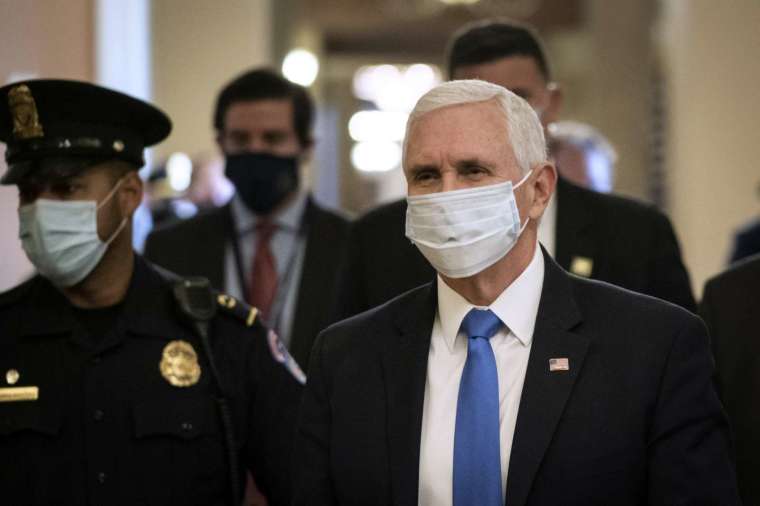
the 25th Amendment to the U.S. Constitution, Vice President Mike Pence
is first in line to take over as acting president if Trump no longer has
the capacity to carry out his duties -- from nominating Supreme Court
justices to commanding America's military forces and nuclear arsenal.
House Speaker Nancy Pelosi is next in line under federal law.
A
written declaration for this purpose must be transmitted to Congress by
Trump -- or, if he is too sick to even do that, by Pence and a majority
of either Trump's cabinet "or of such other body as Congress may by law
provide."
To return to his duties, Trump must write to Congress again.
Could such an event delay the election, which falls on Nov. 3 this year?
"No,
this will not cause a delay in the election, the date of which is
required by federal law," Rebecca Green, co-director of the Election Law
Program at William & Mary Law School, told Nikkei Asia.
Congress
does have the power to amend the law and select a different election
day. But its House of Representatives, currently under the Democratic
Party's control, is extremely unlikely to do so for Trump.
The U.S. has never delayed a presidential election before, even in wartime.
If a presidential candidate is deceased or incapacitated before the election, does he stay on the ballot?
Each party's national committee has the power to replace its candidate on the ballot.
But
this close to the election, with early and mail-in voting already
underway, "it seems impossible for candidates to come up with a new name
to replace a name on the ballot without starting the whole election
process over," argued Rick Hasen, professor of law and political science
at the University of California, Irvine, on his Election Law Blog.
"While
things are not certain, what's most likely that the election would take
place on time with the deceased or incapacitated candidate's name on
the ballot," Hasen wrote.
How would a candidate's incapacitation or death affect how Electoral College electors cast their votes?
After
Americans cast their votes for president, members of the Electoral
College formally vote in December for the candidate who won in their
respective states.
"The question becomes whether state law gives
Electoral College electors the ability to vote for someone other than
the winner of the popular vote in their state," William & Mary's
Green said.
In certain states, electors are legally bound to cast
their votes for the popular winner in their state -- a rule upheld by
the Supreme Court this July. But the ruling "did not resolve whether
electors could constitutionally vote for someone besides the popular
winner in their state in the event that person dies after the election
but before the Electoral College votes," Green said.
New York
University constitutional law professor Richard Pildes holds that even
in states where electors are formally bound to vote for a dead or
incapacitated candidate, they will vote for the replacement identified
by the party committee.
What are the implications of different electoral vote scenarios?
"If
the RNC [Republican National Committee] were deeply divided, and
Republican electors then did not coalesce around a single replacement
candidate, there might not be a majority winner in the electoral
college," Pildes wrote in a Washington Post analysis. "In that case, the
House would choose the president from among the top three vote getters
in the electoral college. In that process, each state delegation gets
one vote."
UC Irvine's Hasen thinks that in the event Trump can no
longer serve, the flexibility of the Electoral College "could lead to a
whole lot of mischief if, say, the Pennsylvania Republican legislature
tried, over the Democratic governor's objection, to appoint electors to
vote for Pence" despite a vote by the people of Pennsylvania for Biden
over Trump.
“I’m
not saying this is much to do about nothing, I am saying that people
should have a buy list ready,” CNBC’s Jim Cramer said Friday after
President Trump’s positive coronavirus test.
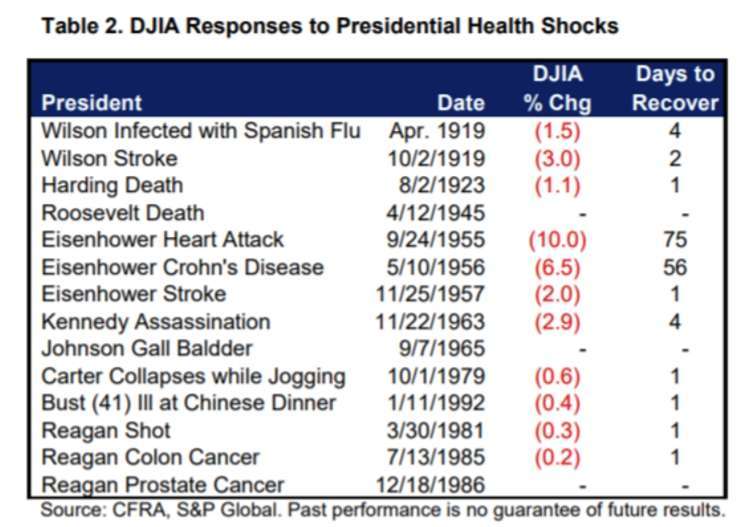
Stock futures were sharply lower following the overnight announcement.
The “Mad Money” host said that he hopes more Americans wear masks to prevent transmission of the virus.
“I’m not saying this is much to do about nothing,” Cramer said on “Squawk Box.” “I am saying that people should have a buy list ready.”
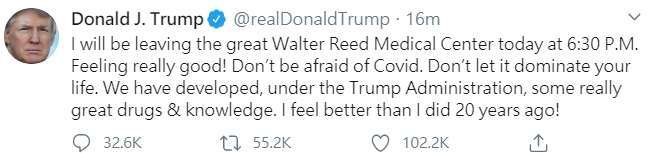
Stock futures were sharply lower Friday morning as Wall Street digested the news that Trump and the first lady, Melania Trump, tested positive for the coronavirus. The president wrote in a tweet early Friday morning, “We will begin our quarantine and recovery process immediately. We will get through this TOGETHER!”
Equities dropped in early trading but pared some of those losses in the afternoon on hopes for a stimulus agreement.
After Cramer spoke, stocks went on to pare some of their early losses in afternoon trading on hopes for a stimulus agreement.
The
Trumps’ positive tests came hours after White House advisor Hope Hicks
also tested positive for the coronavirus. Hicks had traveled on Air
Force One with the Trumps to Cleveland for Tuesday night’s first
presidential debate.
Vice President Mike Pence and second lady Karen Pence have tested negative for the virus, the White House announced Friday morning.
Cramer
wished the Trumps a fast recovery and stressed the environment was not
“business as usual.” But he added, “I do believe there will be many
stocks that will initially go down, like a Tesla — by the way, we had deliveries that were better than expected — and then they can rally.”
“I think that can be like a Ford Motor, where I believe the numbers are going to come in better, and I would be looking to buy something like that,” the “Mad Money” host also said.
Cramer
said he hopes the president’s coronavirus infection convinces more
Americans to wear masks to prevent the spread of the virus, which could
have benefits for the U.S. economy.
Cramer noted Trump has largely eschewed mask-wearing during the pandemic and earlier this week chided his Democratic rival, Joe Biden, for how frequently he wears a mask.
Biden on Friday morning wished the Trumps well.
“Masks
are the only hope we really have, particularly indoors,” Cramer
said. “Maybe the notion that you’re somehow ‘not tough’ [if you] wear a
mask goes away.”
“If you try to reopen the economy aggressively
without masks, without more discipline on social distancing, well it’s
going to fail,” Cramer added. “I think that’s really the ultimate
takeaway of what happened with the president being infected with Covid.”